You're Wrong About Anorexia
The thing no one mentions when we talk about ultra-thinness.

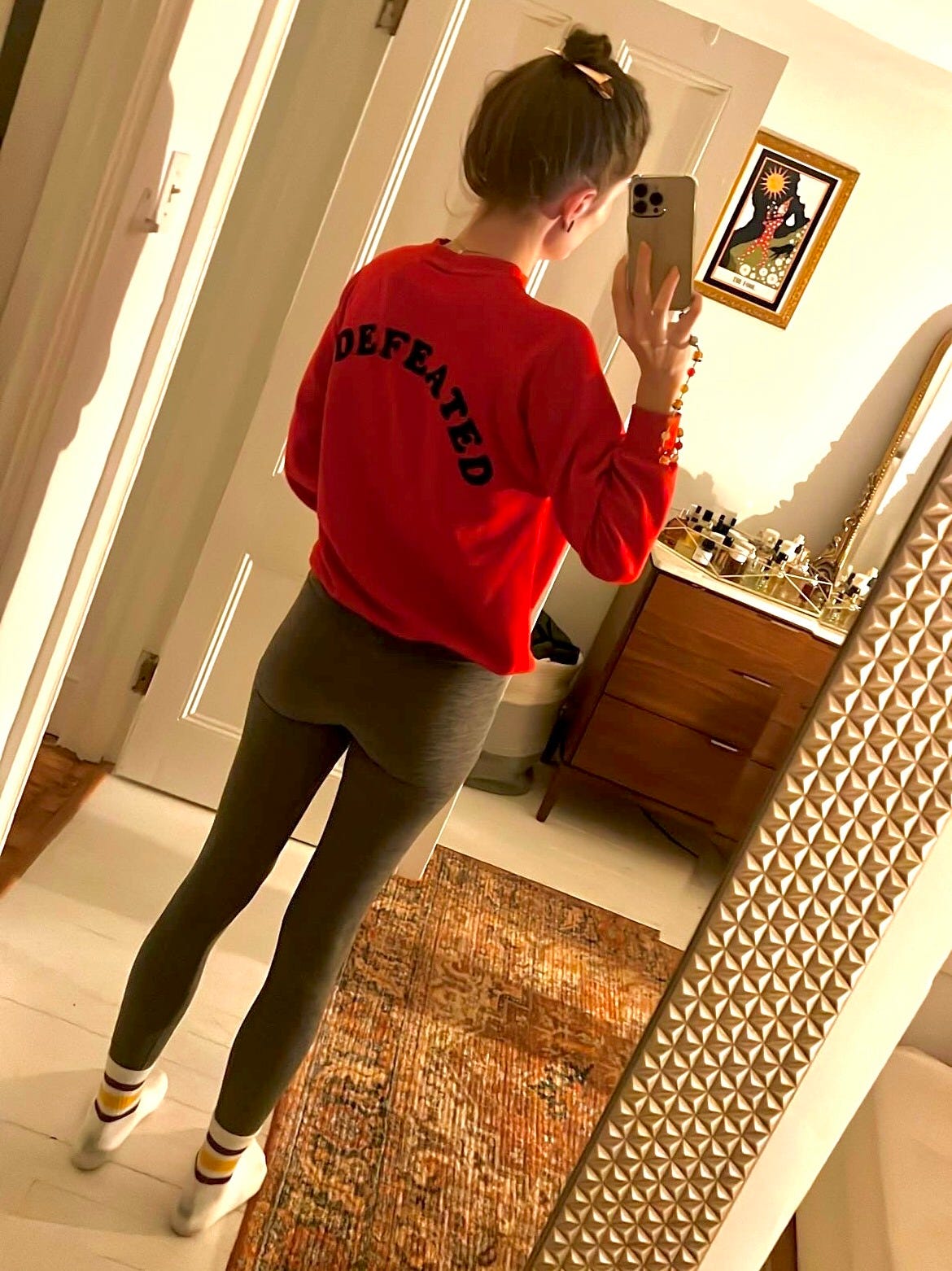
I’ve been accused of being anorexic my entire life. It started at home and found its way, mysteriously… to the halls of my school where the word (among other terrible things) was shouted at me between classes by bullies who happened to spy me from a distance. When I finally revealed in confidence that yes, I have suffered with disordered eating (chicken? egg? who can say) for most of my life, said family acted like they’d caught me in a lie: “finally, she admits it.”
When you find other people in this community, who have invited criticism about their own bodies from strangers by virtue of simply existing while starving, they share the confusion I felt in those moments; like someone caught you copying answers on the test. That’s why it’s so easy for her. She cheated. That’s not it, at all.
When I met my fiancé, Alex, our conversation started with a passion for vanilla, then french fries, then shaved ice. Shaved ice is a bit of a dog whistle for EDs in my mind, since it’s probably the most satisfying dessert with the fewest calories you can find. In that moment I felt comfortable confessing that I had suffered with a restrictive eating disorder from around ages 15 to 25. He then shocked me by sharing that his started at age eight, and continued until he was nearly 30.
I’ve collected close friends over my life who have this in common with me, but having it in a partner has been such a source of compassion and understanding. We are able to talk candidly about our broken brains, about how changes in our routine make us feel sluggish and worthless, or how body dysmorphia oddly drops off when you’ve had just enough to drink to stop worrying for a moment and catch sight of yourself in a mirror. He watches me eat candy to stave off hunger for a couple more hours so I can really enjoy my dinner. I hear him crack a Celsius and know, lovingly, sympathetically, that he’s doing the same. I get impatient and go lightheaded when I stand up. He gets intensely focused and quiet. We recognize it for what it is and talk about it openly. It’s never accusatory. While most onlookers who have never been in that mindset would want to sound the alarms and call you names, we understand that this is what management looks like sometimes.
And it won’t always be like this. There has been so much change lately, mainly him moving out of the city and buying a house with me, that our routines have been completely disrupted. When you feel out of control, you restrict. Even though we are considered “in recovery,” restrictive eating disorders never leave you. We understand that this phase will pass, things will stabilize again. We keep each other accountable, and we are also understanding about the way the ED brain makes its demands un-ignorable sometimes.
When you’ve spent so much of your life focusing on food — and specifically not eating it — you develop a sort of radar for your kind. We were on a long walk on a nearby trail a couple of weeks ago, taking a comfortable pace, when a tiny woman breezed past us with a smile, walking so briskly that she overtook us and disappeared soon after, but as she passed Alex and I shared a knowing look. Her clothes hung from her body. Her hair was thin. She had probably been walking like that for hours. Call us judgmental (we are), but she carried all the hallmarks of being one of us. Sure, there are many reasons someone might be very thin, but there is a specific vibration to someone who has had this particular monkey on their back their whole life, and you know it when you see it.
To some extent I think it’s in our human nature to be concerned when we see someone starving. Yes, it’s viscerally alarming to see a person in their 40s with the exposed bone structure and low muscle mass of a tween about to hit puberty. Something evolutionary commands us to help them.
But that concern becomes contempt so quickly in the typical onlooker that it’s forced disordered eating and its victims into a category of people who have taken an unfair shortcut in life. Herein lies the irrational cognitive leap that is far more the rule than the exception. The line, “well I could be that thin if I had an eating disorder, too,” is one of the most mind bending tropes this community experiences. And we experience it A LOT.
“You’re so thin, what are you, anorexic?”
Yes, you fuck.
“Well you can eat anything, look at you.”
You’re confusing cause and effect, my guy.
“Wish I had that problem.”
No. You don’t.
Anorexia and other restrictive eating disorders (mine was orthorexia, but it looked the same from the outside) often have a physical manifestation that makes their sufferers look adherent to a modellesque body standard many people feel makes them fair game to comment on. Something about the surreal achievement of such thinness makes folks assume you’re proud of it, that you’re rubbing their nose in it, and if they can assign a cheat code to it, it assuages the discomfort they feel in comparison to it. A thin person’s very appearance seems to broadcast a desire to be noticed, like you walked into the room and said, “look at me, I’m thinner than you, therefore I’m better than you.” But we said no such thing. You concocted that shit in your head and responded to it to our faces. You’re a fucking asshole.
The truth is, while on the whole it’s definitely a valuable skill to be able to manage your weight effectively, that skill is a mere byproduct of the overwhelming fatphobia we are all battling in our brains every moment of every day. And that’s when you’re recovered! When you’re in the thick of it, you’ve overridden your body’s natural hunger cues and you’re thinking about food, food and only food all day every day, except never eating it. We are not proud of our physique in real time. Perhaps later in a photo, but present reality never makes it past the goal line. We are unsatisfied, disgusted by ourselves and in serious physical pain.
The fatphobia conversation is another great example of this strange logical fallacy: You are fatphobic, and that makes you an intolerant person. A bigot. What a colossal missed opportunity that angle is.
Fatphobia is like white supremacy and systemic racism. We need to admit it’s built into the game by the people who stand to benefit most from it, and stop seeing it as a direct attack on our individual character. It’s something we were absolutely steeped in for our entire lives, regardless of our current weight or appearance, and we need to look around and see each other as allies within a fucked up system instead of enemies based on what our bodies look like. We are all suffering with it, and its ability to polarize us is what keeps the system itself safe from scrutiny.
And we can’t (it appears, by virtue of the sheer volume of articles to this effect being published every day) talk about fatphobia and thinness without talking about GLP-1s. If there is any solid fact to be drawn from the wildly nuanced public Ozempic discourse, I would say it’s that humans are extremely emotionally attached to weight as a concept. A celebrity going from thin to alarmingly thin becomes personal to everyone with eyes, simply by virtue of that person’s malady having such visible consequences. You could argue, yes, their goal was to be so thin, but by drug or sheer will, that person is trying to find a version of themselves worthy of love.
It has nothing to do with you.
Ozempic criticism is a funny thing to me because again, the idea that someone is using a “cheat code” to get super thin presumes that their reward, their thinness, doesn’t come with the side effects of someone being super thin by pure mental will to starve. Of course it does. When you’re depriving your body of sustenance, starvation does the same thing to your body no matter the cause. You’re exhausted, depressed, anxious, your hormones stop working, your brain gets slow…you’re dying, or toying with your limits at the very least.
The argument is that GLP-1s take away the brain chatter, which is a godsend for some. But human nature will always seek extremes, and a new technology will always be exploited to that end. If it’s there, we will game it.
Lately, an absolutely horrifying stream of emails has been spewing from a fitness influencer Alex had previously followed, who has recently lost the plot completely at the hands of “Tirzeppy.” This man, a body builder, has used Tirzepatide, an injection that mimics natural gut hormones to suppress appetite and slow digestion, to go from an Olympic lowness of body fat to virtually zero, without those pesky food cravings. He’s insatiable. He is now selling this drug to his subscribers through his own backchannels. The manic tone of his emails sounds like the ramblings of a madman, an addict, not a role model for health or well-being of any kind. He has the physique of a Greek god, but at what cost?
I say all this to ground my main crystal of truth here: There is no happiness while ultra-thin. We’ve attacked it from all sides, tried to sneak up on it and outsmart it, and we will no doubt continue to, but facts are facts. When you’re starving, your body is shutting down. You can sustain it for a long time because our bodies are incredible, and they have a lot of internal mechanisms that keep us alive under duress, but ask anyone to look at a photo of themselves at an enviably low weight, and they will tell you, “that’s the unhappiest I’ve ever been in my life.”
Women need fat to store hormones to keep our energy up, our brains working, our periods coming, and our hair from falling out. Men need fat for similar reasons and so they can get an erection. To say the quiet thing loud, a penis haver who whittles himself down to a marble statue is not getting hard-ons. And I ask you, what is the point of being hot if you cannot fuck? (Not to mention, hetero men, women would rather have more time with you than for your body to be “perfect” by looksmaxxing standards. Hotness ≠ Fuckability.)
It’s a weird paradox, right? There is a standard of attractiveness that implies that we all want this, then it makes those who go to extremes to achieve it sacrificial lambs for the masses to ridicule, all while none of us is happy. If you think that’s an accident you’re wrong. Happy people don’t compulsively buy things to soothe their insecurities. Happiness is not profitable. It’s always about money, because of course it is.
But if there’s one point to take away from this if you’ve never had any form of restrictive disordered eating, it’s that we don’t think we’re better than you. We aren’t thinking about you at all. An eating disorder is extremely private. The thinness is for the sufferer, not for you. It just happens to have very visible side effects. Try not to confuse the two.
The E.D. Hotline in the US is: 1-866-662-1235
Find more resources on E.D. recovery here.
As you know, what helped me finally take the step towards wanting to actually change my behavior was hearing an acquaintance share her story so openly on a podcast. It was then that I knew my internal monologue was not special or unique, but rather shared in a collective brain suspended in the universe. For far too long, the restrictive had to walk through life acknowledging each other with a "Fight Club" style nod. You've shared here so beautifully for the both of us, and I'm endlessly proud of the vulnerability you choose to approach the world with.
Some of my darkest memories are from during my 30s when a particularly unrelenting period of OCD was throttling the life out of me. I remember being so so tiny, clutching a tin of soup at the grocery store and sobbing because I hadn't been able to move from the spot for what seemed like an eternity. I was afraid of food and was reading the label over and over, trying to allow myself to find this soup safe enough to consume. During the worst of it I was living off those energy drinks you give cancer patients and Reeses Peanut Butter cups.
Recovery was like fighting my way out of a body bag, and having survived with precious little fuel in my system. I took what joy I could in my mind opening itself to food again, but it was so diminished by how I felt about my body getting larger. Sure, I hated my deflated boobs when I was at my lightest but those could be hidden and enhanced. I was damn well aware that the spindles I had for arms and legs were deemed enviable. As though a large part of my visual merit was simply down to how far someone could throw me. It made no sense. But then of course it did. The pool in which society finds ways to drown us is deep and wide.
I'm grateful that you talk about this sort of thing, and about not being entirely better. I weigh a bit more than I would perhaps like, but I'm largely (ha) ok with that in principle. But the fears still prickle at the back of my mind. Perversely I'm now too afraid of peanut butter to even touch it. I haven't filled my diet with the healthy foods I need, but rather a subsistence smorgasbord of what is at least 70% garbage. I do what I can. I keep myself in a narrow band of acceptable weight - not too high, not too low. I'm in my 40s, so it's likely all a waning moon from here anyway. I try to just let myself enjoy dressing this body in pretty things, putting food in it, letting my partner revel in it even if I find it a bit bewildering. What else is there for it?